Best Text-to-Speech Software: 7 Free & Paid Tools for Commercial Use
Ondoku Case Study: Adire Law Firm Boosts Satisfaction and Efficiency!
Sept. 9, 2026
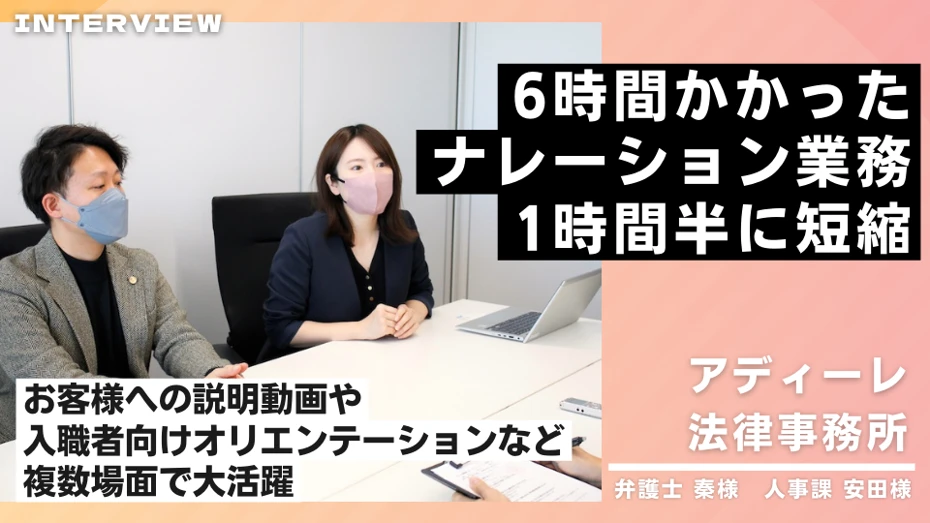
- Adire Law Office
- Size: More than 1,100 people, more than 220 attorneys (as of October 31, 2023)
- Industry: Law Office
- Interview: Attorney Kazumasa Hata (Member of Tokyo Bar Association)
: Personnel Department, Mr./Ms. Yasuda
Objectives / Challenges
Used for narration in explanation videos at the time of contract and staff education materials. Preparing to create high-quality content and the process of recording human voices takes an enormous amount of time and effort.
Solution
Eliminate in-house voice recording and create narration using Ondoku.
Results
Significant time savings by eliminating the need for detailed script preparation and re-recording.
Contributed to operational efficiency by utilizing the created videos in various locations.
Introduction to the Company and Department

Attorney Mr. Hata (hereafter, Hata): We are a general law office that primarily handles individual concerns such as debt problems, domestic troubles, and claims for government benefits related to Hepatitis B.
Traditional law offices somehow feel like they have a high threshold, and it takes courage to consult with them. We continue our activities with the goal of being a "familiar law office" to change that situation.
For example, placing approachable advertisements and having a system in place where people can easily consult over the phone are strengths of our office. Also, we make an effort to explain things without using technical terms as much as possible, aiming to make attorneys feel more accessible.
HP: Adire Law Office
Please tell us about the background behind introducing the text-to-speech tool.

Hata: Currently, we provide explanations to our clients not only verbally or in writing but also through videos. Previously, it was verbal or written, but as a result of pursuing clarity, we felt it was important to provide videos that include illustrations and movement.
To create high-quality videos, we must also focus on narration. However, even when recording with staff voices, re-takes occurred many times, taking an enormous amount of time.
Also, from the perspective of the recording environment, situations where phone sounds or footsteps can be heard from outside are problems that cannot be avoided no matter how careful we are.
As a result, it took a significant amount of effort and time to create the videos.
Mr./Ms. Yasuda, Personnel Department (hereafter, Yasuda): In the Personnel Department, every time we held an orientation for new hires, we spent half a day giving the same explanation. Therefore, we thought that even if it wasn't a person explaining, playing a video that could be properly understood would lead to operational efficiency.
We felt that a text-to-speech tool that can easily generate narration would allow us to take the step toward creating videos, so we decided to introduce it.
Could you tell us how you came to introduce Ondoku?
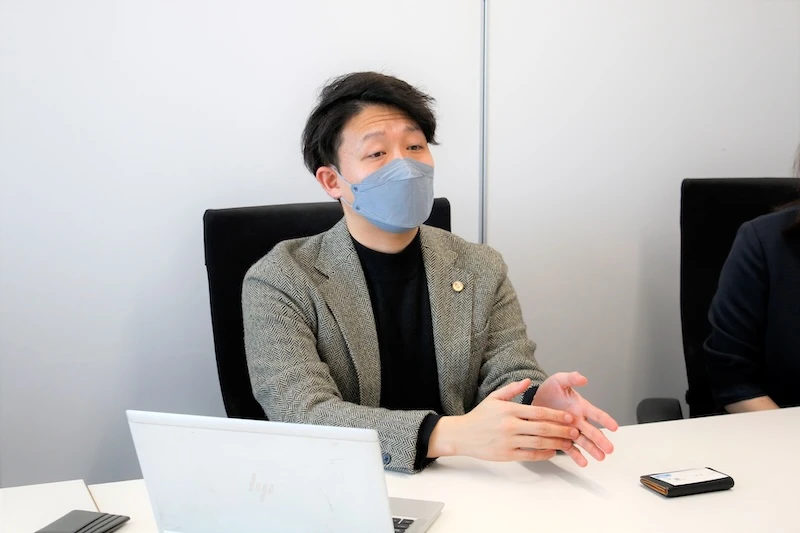
Hata: The low price and ease of use were the deciding factors.
Especially regarding ease of use, we valued the interface, which can be operated intuitively. The notation for text boxes and downloads is clear, and there is no confusion when using it.
Also, since we create materials for clients, the fact that commercial use was okay was an indispensable point. We decided to introduce it because we thought Ondoku, which can be used smoothly, could solve the problem of narration taking an enormous amount of time.
Have the challenges been solved (improved) compared to before introducing Ondoku?

Hata: Previously, it could take about 6 hours to record the voice for a video material of about 10 minutes.
I think it took 3 hours just to write a script so that the staff recording the voice could read it without hesitation. This was because we had to succeed in recording in one go, so a perfect script was necessary. To maintain quality at the level of every single word and phrase, I checked it by reading aloud many times.
Also, if even a little bit of external sound got in, we would record it again, and so on; we were very strict about it, so time was being consumed rapidly.
However, the narration work is now completed in about an hour and a half. Thanks to human voices being no longer necessary, detailed scripts are no longer needed, and the effort of re-takes has decreased, which is a big factor.
Yasuda: The start of video creation within the Personnel Department was triggered by the introduction of Ondoku. Until then, the hurdle to making videos was so high that it was difficult to get started.
Orientations for new hires are conducted for both new graduates and mid-career hires, so it is not uncommon for them to be held about 10 times a month. At each time, the Personnel Department was stuck giving explanations.
For business improvement, we tried incorporating videos with narration made by Ondoku into the training. As a result, we found that understanding equivalent to verbal explanation was being obtained, and Personnel Department members are now able to spend time on tasks other than orientation.
Have you received any feedback regarding Ondoku within the office?

Yasuda: With the realization of video materials, we have received feedback that the contents of the orientation can now be reviewed at any time.
We make it possible to review the explanation videos for new hires using Ondoku at any time through shared data. Thanks to this, we have realized a system where parts that cannot be recalled from a text-base can be easily re-learned through video.
Also, staff assigned to branches nationwide can progress their learning efficiently through video sharing from the headquarters.
If you have any further requests for improvement for Ondoku, please let us know.
Yasuda: It would be even easier to use if fine-tuning of intonation could be improved. Especially when making long sentences, we have to use ingenuity such as cutting sentences short until they sound as expected.
Hata: I thought it would be more convenient if there were something like a clear manual. Currently, I am in a state of creating audio that sounds natural through my own trial and error.
If Ondoku could provide something that shows tips for use, we might be able to create time to focus on the intonation of technical terms.
How would you like to use Ondoku in the future?
Hata: I hope to utilize Ondoku to strengthen education programs.
For example, something where you choose the correct answer from options and progress like an RPG. If there is training that can be practiced like a game, people can learn while having fun.
However, I think narration will be an important element for that, so I would like Ondoku to play an active role at that time.
Yasuda: In the Personnel Department, we plan to upload videos that job seekers, including new graduates, can easily watch on SNS. I would like Ondoku to solve all the narration problems that arise each time in those.
By utilizing Ondoku, you were able to efficiently create narration of a quality that can be provided to customers, and significantly reduce time and effort by using it for internal education! Thank you very much for sharing such a wonderful case study.


Ondoku is a text-to-speech service that can be used for commercial purposes for free. It supports 81 languages and regions, with a total of over 692 speakers. Click here to listen to the voice types and sample audio for supported languages.
■ AI voice synthesis software "Ondoku"
"Ondoku" is an online text-to-speech tool that can be used with no initial costs.
- Supports 81 languages and regions, including Japanese, English, Chinese, Korean, Spanish, French, and German
- Available from both PC and smartphone
- Suitable for business, education, entertainment, etc.
- No installation required, can be used immediately from your browser
- Supports reading from images
To use it, simply enter text or upload a file on the site. A natural-sounding audio file will be generated within seconds. You can use voice synthesis up to 5,000 characters for free, so please give it a try.

Text-to-speech software "Ondoku" can read out 5000 characters every month with AI voice for free.
You can easily download MP3s and commercial use is also possible.
If you sign up for free, you can convert up to 5,000 characters per month for free from text to speech.
Try Ondoku now.
HP:
ondoku3.com
Email: ondoku3.com@gmail.com
Email: ondoku3.com@gmail.com
Related posts
"Ondoku" is a Text-to-Speech service that anyone can use for free without installation. If you register for free, you can get up to 5000 characters for free each month. Register now for free
- What is Ondoku
- Start text-to-speech conversion
- Free registration
- Pricing
- Posts
- Try other free services