Recommended Text-to-Speech Software Summary: 7 Selections for Commercial Use [Free and Paid]
Video quality improved & members supported with the introduction of Ondoku! Case study of Kobelco Health Insurance Association
Jan. 26, 2026
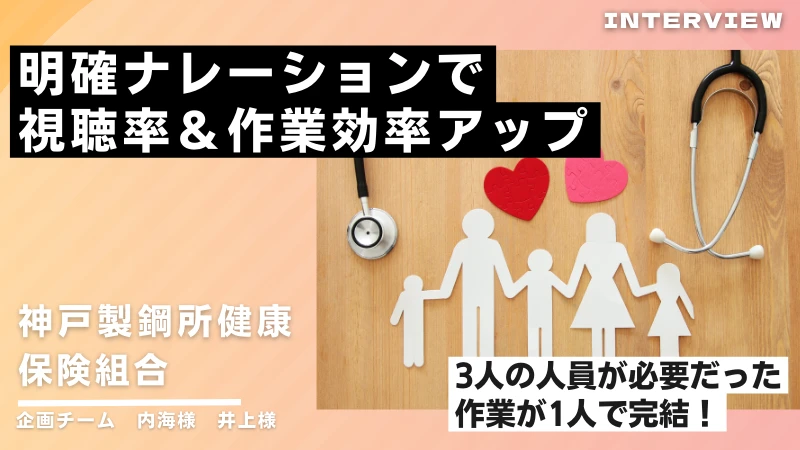
- Kobe Steel Health Insurance Association
- Scale: Approx. 50,000 users (including employees and families)
- Industry: Health Insurance Association
- Interview: Health Group, Planning Team
Mr. Utsumi, Mr. Inoue
Objectives/Challenges
There were comments that users did not know how to participate in or record for Pep Up (health portal site) events. Although we created videos focusing on ease of understanding, the quality was low and did not lead to results.
Solution
Introduce Ondoku to improve video quality with bright voices and accurate intonation.
Effects
The number of views for videos using Ondoku increased, and comments about difficulty in understanding participation or recording methods decreased. Furthermore, tasks that previously required three people can now be completed by one person, and its use is spreading to other departments.
Introduction of the Company and the Department

We are a health insurance association with Kobe Steel, Ltd. as our parent organization. Our members include employees from a wide range of industries including steel, aluminum, casting and forging, welding, machinery, engineering, and electric power, including affiliated companies.
The Planning Team of the Health Group, which uses Ondoku, is a department that plans health support measures based on data health plans. In addition to planning new events for health promotion, we also review systems to keep pace with the times.
A major strength of our association is the utilization of the health portal site "Pep Up." Pep Up is a service where users can check their health checkup results via PC or smartphone and receive points (incentives) for participating in health promotion events. Approximately 80% of health insurance members are registered, and we feel that we are successfully communicating health promotion through Pep Up.
Please tell us about the background of why you introduced the text-to-speech tool.
We decided to introduce a text-to-speech tool because we felt the need to improve the quality of our video services.
Our association holds health promotion activities such as walking events on Pep Up. At that time, we were concerned that the implementation guidelines disclosed were too text-heavy to fully communicate to members. In surveys for members, there were comments that information was difficult to convey with text alone, so we decided to start providing videos that could communicate via audio.
We immediately created and published videos using staff voices, but they felt homemade and could not be called high-quality videos. Nonetheless, there is no doubt that audio is often easier to convey than text. While considering further quality improvements to cater to a wide range of employees, we came across a text-to-speech service.
Could you tell us how you came to introduce Ondoku?

We decided to introduce it after evaluating Ondoku's ease of use and high quality.
While comparing it with other services, its good balance, including cost, stood out.
One reason we feel the quality is high is the beautiful audio, which is at a level suitable for providing to members.
Additionally, since we are from the Kansai region, we inevitably cannot speak standard Japanese perfectly. The ability to clear such intonation issues is perhaps the appeal of Ondoku.
When staff members were actually recording audio, dialects and surrounding noise were problematic.
However, with Ondoku, we can provide audio that is easy to hear, so we thought it was ideal for improving video quality.
Compared to before introducing Ondoku, has the challenge been solved (improved)?

Since introducing Ondoku, not only have video views increased, but the number of people who stop watching halfway has also decreased.
I believe this is proof that the quality has improved and people are watching properly.
Furthermore, we are seeing results in reducing human costs.
Until now, a total of three people were required, including the person in charge of creating the video and the person recording the audio. Just coordinating everyone's schedule was difficult, and we had to re-record many times while worrying about noise.
However, since we started using Ondoku, the work can now be completed by one person.
Also, it is significant that we are no longer affected by the condition of the person recording the voice and can guarantee a certain level of quality.
Please tell us if there are any other examples of how you are utilizing Ondoku.
Actually, the use of Ondoku is spreading not only in our Planning Team but also in other departments.
Recently, those in charge of the insurance benefit system have started using Ondoku to create videos to make difficult systems easier to understand.
Please let us know if you have any further requests for improvement for Ondoku.
There are times when I feel the intonation is different. Also, I have heard feedback that question forms often have the intonation of affirmative sentences.
Additionally, it might be nice to have a little more variety in voices.
Currently, there are mostly orthodox voices, so it would be useful if we could use characters with slightly high-pitched voices, like in anime, for example.
Furthermore, I would like to suggest music and sound effects as features to be added.
In particular, if there were sound effects that could be easily used before narration starts or at the end, video creation could be completed within Ondoku alone. Currently, we download them from other sites and use them in combination.
How do you intend to use Ondoku in the future?
We are considering whether we can utilize Ondoku for some parts of the health classes conducted by our association.
The lectures themselves can be as long as 50 minutes, so we are still considering to what extent we will use Ondoku.
Currently, we are planning to overhaul our website to provide better clarity.
Specifically, we plan to create a video section to distribute information on insurance benefit systems and Pep Up events.
Furthermore, there is a movement to actively utilize Ondoku in public relations as well. We would like to play videos using Ondoku on televisions in the cafeterias of each business site to carry out promotions that lead to health promotion.
The quality of the videos you provide to your customers has improved through the use of Ondoku, leading to more views and prevention of drop-offs! Thank you for sharing such a wonderful case study.


Ondoku is a text-to-speech service that can be used for commercial purposes for free. It supports 80 languages and dialects, with a total of over 650 speakers. You can listen to the types of voices and sample audio for supported languages here.
■ AI voice synthesis software "Ondoku"
"Ondoku" is an online text-to-speech tool that can be used with no initial costs.
- Supports approximately 50 languages, including Japanese, English, Chinese, Korean, Spanish, French, and German
- Available from both PC and smartphone
- Suitable for business, education, entertainment, etc.
- No installation required, can be used immediately from your browser
- Supports reading from images
To use it, simply enter text or upload a file on the site. A natural-sounding audio file will be generated within seconds. You can use voice synthesis up to 5,000 characters for free, so please give it a try.

Text-to-speech software "Ondoku" can read out 5000 characters every month with AI voice for free.
You can easily download MP3s and commercial use is also possible.
If you sign up for free, you can convert up to 5,000 characters per month for free from text to speech.
Try Ondoku now.
HP:
ondoku3.com
Email: ondoku3.com@gmail.com
Email: ondoku3.com@gmail.com
Related posts
"Ondoku" is a Text-to-Speech service that anyone can use for free without installation. If you register for free, you can get up to 5000 characters for free each month. Register now for free
- What is Ondoku
- Start text-to-speech conversion
- Free registration
- Pricing
- Posts
- Try other free services