Recommended Text-to-Speech Software Summary: 7 Selections for Commercial Use [Free and Paid]
[Complete Guide] How to Do English Shadowing? Explaining How to Create Study Materials for Free!
Jan. 26, 2026
![[Complete Guide] How to Do English Shadowing? Explaining How to Create Study Materials for Free!](https://storage.googleapis.com/ondoku3/image/20250522_shadowing_tmb_02_930.webp)
I want to know how to do shadowing!

Shadowing is a highly effective practice method when learning English and other languages.
For those who want to improve English listening skills and pronunciation, shadowing is a very effective learning technique.
In this article, we will explain in detail how even beginners can practice shadowing, from the basics to applications!
Of course, it can also be used for languages other than English, such as French, German, Spanish, Chinese, and Korean.
Let's gain a correct understanding and practice method of shadowing to efficiently improve your language skills.
[Free] AI Text-to-Speech Service "Ondoku" Recommended for Shadowing Materials

The most important part of shadowing is preparing the audio for the material.
In such cases, we recommend "Ondoku".
"Ondoku" is an AI service that can read text aloud with native pronunciation.
Since it can read English and other languages with native pronunciation, you can create the perfect audio for your materials!
You can use text that fits your specific needs as learning material, which is also ideal for increasing learning motivation.
Furthermore, "Ondoku" allows you to read up to 5,000 characters for free, so you can create shadowing materials right away.
Why not use "Ondoku" for your English or foreign language studies?
What is Shadowing? Basic Knowledge & Reasons Why It's Highly Effective for English Learning!
First, let's briefly explain shadowing.
What are the features of shadowing? Recommended for studying English and foreign languages

Shadowing is a learning method where you listen to audio and speak by mimicking it almost simultaneously.
It is a highly effective method for studying listening, speaking, and pronunciation for English and other foreign languages.
It is also known as a training method for interpreters, and it gets its name from following the incoming audio like a "shadow."
A major difference from general reading aloud is that you rely solely on the audio coming into your ears without looking at the text.
It might feel like just pronunciation practice, but it actually has the effect of comprehensively training listening, speaking, pronunciation, and sense of rhythm!
It can be said to be a learning method that makes language acquisition more efficient by performing "input" and "output" simultaneously during the English learning process.
Why is shadowing effective? English learning and the brain's language processing mechanism
The reason why English shadowing is effective is deeply related to the brain's language processing mechanism.
When our brains process language, they go through multiple processes: "listening," "understanding," and "speaking."
In normal conversation, these processes occur sequentially, but in shadowing, they occur simultaneously, which activates the brain more.
Shadowing is also said to strengthen short-term memory called "working memory," which helps in remembering English sentences and expressions more efficiently.
In this way, shadowing is a learning method whose effectiveness is supported by neuroscience.
4 English Skills Trained by Shadowing

By practicing English shadowing continuously, four important skills will effectively improve.
First is listening ability.
Because you develop the ability to immediately understand and process English audio, you will be able to handle the natural speaking style of native speakers.
Next is pronunciation.
By repeatedly mimicking native pronunciation, you will acquire natural pronunciation and intonation.
Also, you will gain speaking fluency.
By getting used to speaking English, your response speed and smoothness in actual conversations will improve.
And you can also acquire the rhythm characteristic of English.
English has unique rhythms and patterns, which you can master through shadowing.
These skills are interrelated.
With shadowing, you can strengthen four skills simultaneously.
You can study English and other foreign languages in a comprehensive and balanced way.
That is the reason why shadowing is so effective.
Effects of Shadowing by English Learner Level
English shadowing shows effects regardless of the learner's level, but the way those effects appear differs depending on the level.
For beginners, it has a great effect on getting used to English sounds and improving basic pronunciation.
Since you can learn the sounds and rhythms of English with your body, you will be able to naturally acquire the flow of sounds characteristic of English.
For intermediate learners, you can use words and expressions you already know more naturally and improve your conversation speed and fluency.
Listening ability will also improve dramatically, allowing you to keep up with the speed of natural English.
For advanced learners, it is effective for acquiring native-like pronunciation, intonation, and subtle nuances.
Because you will be able to immediately understand and use complex grammatical structures and expressions, you can further refine your high-level English skills.
Thus, English shadowing brings different effects according to the learner's level.
Shadowing is the ideal study method for continuous growth.
[Explained with English Learning as an Example] What is the Flow of Shadowing?

Specifically, how do I study English with shadowing?
Now, we will explain the specific method of shadowing using English study as an example!
1. Prepare Audio Materials for Shadowing

When starting English shadowing, the first important thing is to prepare audio materials.
There are three points to consider when preparing audio materials:
- Content slightly above your level (neither too easy nor too difficult)
- Clear pronunciation
- Appropriate speed
Specifically,
- Beginners: Language programs on the radio, CDs included with introductory books
- Intermediate and above: TED Talks, podcasts, parts of movies or dramas
These are standard materials.
Furthermore, there is a recommended method that can be used by everyone from beginners to advanced learners!
That is creating audio materials from English text using an AI text-to-speech service.
It's often difficult to find shadowing audio that perfectly fits your specific needs, such as for travel, business, or hobby activities.
In such cases, by using an AI text-to-speech service like "Ondoku", you can create English audio pinpointed to your field of interest.
"Ondoku" can be used for free, so you can get materials as soon as you want to study.
We also introduce example sentences perfect for shadowing in this article, so please check it out!
![[Must-read] Improve your English! 100 recommended example sentences for reading aloud - A collection of selected texts for everyone from beginners to advanced users | Text-to-speech software Ondoku](https://storage.googleapis.com/ondoku3/image/20241020_english-reading-example-sentences_tmb_930.webp)
[Free] Flow of Creating English Audio for Shadowing with "Ondoku"
"Ondoku" is an AI service that allows anyone to easily create English audio.
For example, anyone can immediately generate high-quality audio like this!
American English · Female
British English · Male
Alice was beginning to get very tired of sitting by her sister on the bank, and of having nothing to do: once or twice she had peeped into the book her sister was reading, but it had no pictures or conversations in it...
(From the beginning of "Alice's Adventures in Wonderland")
Now, let's look specifically at how to create audio for shadowing with "Ondoku"!
First, open the Ondoku top page.
Paste the English text into the text box.

Select "English" from "Language."

In "Ondoku", you can choose from four types:
- English (USA)
- English (United Kingdom)
- English (Australia)
- English (India)
You can choose according to the pronunciation you want to study, such as American English or British English.
Next, choose the voice to be used for reading, such as female or male.
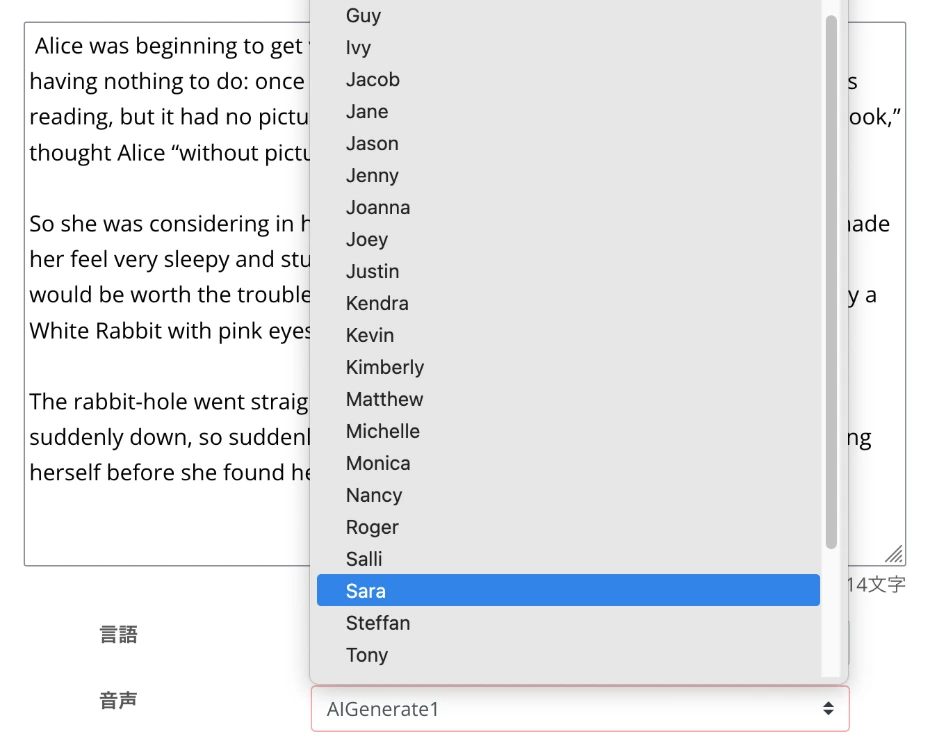
You can listen to samples of the voices available for English reading on this page.

Adjust the reading speed and pitch as necessary.

Now you are ready.
Press "Read aloud" to generate the English audio.

The process is completed immediately, and the audio is played automatically.

In addition to being able to play it on the on-screen audio player, you can also save it in MP3 format.
If it is too fast, try lowering the speed and generating it again.
"Ondoku" allows you to change the playback speed freely like this.
1x
0.5x
0.3x
Amazingly, "Ondoku" allows you to lower the reading speed down to 0.3x, making it ideal for shadowing!
You can practice pronunciation carefully.
In this way, with "Ondoku," anyone can easily create native-pronunciation English audio for free.
Why don't you also start shadowing using "Ondoku"?
2. Practice Slowly While Looking at the Text

Now you have the audio ready for shadowing.
When starting shadowing, let's begin with basic training.
First, play the created audio.
Once the audio starts playing, begin pronouncing the same way about 0.5 to 1 second later.
Don't worry about parts that are difficult to pronounce or parts you can't keep up with; just keep reading without stopping the flow.
At this stage, it's okay to read while looking at the text at first.
Once you get used to it, gradually try to read without looking at the text.
By practicing repeatedly with the same material for about 10 to 15 minutes every day, you can gradually get your body used to English sound patterns.
At first, you might tend to follow word by word, but eventually, you will be able to grasp it by phrase (meaningful chunks).
3. Try Full-Scale Shadowing Once You Get Used to It!

Once you are comfortable with basic training, challenge yourself with more full-scale shadowing.
First, try shadowing at normal speed, such as 1.0x, without looking at the original text.
At this stage, aim to follow the audio while understanding the meaning.
When you are able to shadow smoothly, record your own voice and compare it with the original audio.
Pay particular attention to intonation, rhythm, and the accuracy of individual sounds.
If you created materials with "Ondoku", it's also effective to expand your practice by changing to different voices, speeds, and accents (e.g., from American English to British English) using the same text.
By gradually increasing the difficulty level, you can effectively improve your English skills.
Thus, when shadowing English, we recommend creating materials with "Ondoku".
English shadowing is a learning method that will surely show effects if continued correctly.
Why don't you start English shadowing by preparing materials with "Ondoku" based on this method?
How to Shadow More Effectively? Points for English Learning
There are several points to increase the effectiveness of shadowing.
We will introduce specifically important points.
How to Set Up the Ideal Learning Environment for Shadowing

To perform English shadowing effectively, it is important to set up an appropriate learning environment.
First, secure a quiet place where you can concentrate.
If there is ambient noise, you won't be able to concentrate on the English audio, and the effectiveness of shadowing will be halved.
It is also important to be able to play materials with good sound quality.
Prepare devices such as smartphones, computers, or tablets, along with earphones or headphones.
Using earphones or headphones prevents the material's sound from being recorded together when you record and check your own voice.
If you cannot record while playing music, we recommend playing it on a computer while recording on a smartphone.
Since you will be vocalizing during shadowing, consider choosing an environment and time that won't disturb family or people around you.
Points for Recording and Checking Your Shadowing
When recording and checking your own shadowing, there are several points you should be aware of.
First, regarding pronunciation, check if you are accurately pronouncing sounds that are particularly difficult for Japanese speakers, such as /r/ and /l/, /th/, and /v/ and /b/.
Also pay attention to word stress positions, sentence intonation, and rhythm.
Since English has a clear rhythm of strong and weak sounds, check if the words that should be emphasized are being emphasized correctly.
In terms of speed, how well you are keeping up with the model without delay is also an important indicator.
Check if you are pronouncing all words without omissions or dropouts.
If you summarize these points in notes, the areas for improvement in the next practice session will become clear.
It is also possible to realize your growth by recording and comparing shadowing with the same material about once a week.
By keeping these points in mind when recording and checking your own voice, you can further enhance the effectiveness of English shadowing.
Guidelines for Daily Shadowing Practice Time and Frequency
To perform English shadowing effectively, it is important to set an appropriate practice time and frequency.
For beginners, it is ideal to start with about 10 to 15 minutes per session.
Shadowing is a practice that requires concentration, so continuing for a long time will accumulate fatigue and decrease effectiveness.
Regarding frequency, doing it for a short time every day is most effective.
Even 5 to 15 minutes every day is far more effective than doing it for a long time once a week.
Consistency is key, and regular stimulation is necessary to form English circuits in the brain.
For intermediate learners and above, practice time per session can be extended to 20 to 30 minutes, but keep it within the range where concentration lasts.
Also, repeating the same material at least 5 times will increase the retention rate.
If you practice multiple times a day, it is effective to leave gaps between sessions, such as morning and night.
It is recommended to approach English shadowing with a long-term perspective of 3 months or more, rather than expecting results in a short period.
Don't stop because you don't see immediate results; take your time to study.
The secret to studying English through shadowing is to make a plan that you can continue within a reasonable range.
Practical Techniques for Improving English through Shadowing

To improve English through shadowing, it is recommended to be aware of practical techniques.
From here, we will introduce more practical tips for shadowing.
Tips for Focusing on Prosody (Intonation, Rhythm, Stress)
What's important in English shadowing is not just pronouncing words, but paying attention to prosody, which includes English intonation, rhythm, and stress.
Unlike Japanese, English is a language with stress accents that emphasize specific words or syllables.
During shadowing, pay attention to which words are pronounced strongly and where the voice tone rises and falls.
For example, content words (nouns, verbs, adjectives, adverbs) tend to be pronounced strongly, while function words (articles, prepositions, conjunctions, etc.) tend to be pronounced weakly.
Also, English has a rhythm pattern of "strong-weak-strong-weak," and it is effective to practice so that you can feel this rhythm with your body.
As a practical tip, when you first listen to the model audio, it's good to mark the parts that are pronounced strongly or listen while keeping the rhythm with your hand.
Regarding intonation, be aware of patterns such as the voice rising at the end of a question or falling in a declarative sentence.
By performing shadowing with an awareness of prosody, you will acquire more natural and English-like pronunciation, and the impression you give listeners will change significantly.
Techniques for Capturing Chunks (Meaningful Units)
Equally important are meaningful units called "chunks."
When shadowing English, aim to capture English in "chunks" rather than word by word.
Chunks are groups of words or phrases that are normally used together, and the brains of people who have mastered English process language in these chunk units.
Examples of chunks include:
- "I'd like to"
- "as soon as possible"
- "in the morning"
By being aware of such chunks during shadowing, you can grasp the natural flow of English and speak more smoothly.
As a specific method for being aware of chunks, before starting shadowing, try inserting slashes (/) for each meaningful unit when reading the text.
For example, divide it like "I'd like to / have dinner / at that restaurant / if possible."
Also, when listening to the model audio, pay attention to where the speaker takes subtle breaths and how they group phrases together.
By shadowing in chunk units, you can not only mimic pronunciation but also simultaneously acquire natural English expression patterns.
This also helps in understanding and remembering long sentences, allowing you to speak smoothly in actual English conversation.
Tips and Breathing Techniques for Speaking English Without Interruption
In English shadowing, it is also important to continue speaking smoothly without interruption.
To do this, you need to master appropriate breathing and speaking techniques.
First, as a basic step, take a deep breath and relax your body before shadowing.
If you are tense, your throat will tighten, making smooth speaking difficult.
When actually shadowing, be aware of breathing naturally between chunks (meaningful units).
Breath control should be done at points where native English speakers naturally pause (usually at commas or periods, or between meaningful units).
Also, there is no need to aim for the same speaking speed as a native from the start.
Start at a speed you can continue without strain, and gradually increase the speed.
Even if you get stuck in the middle, don't dwell on that part; prioritize catching up with the audio you hear.
Maintaining the flow is more important than aiming for perfection.
Additionally, performing vocal exercises to loosen mouth muscles and stretching the tongue and lips beforehand will lead to smoother speaking.
By consciously practicing these techniques, uninterrupted English shadowing will become possible, and you will be able to carry out actual conversations more fluently.
Common Stumbling Points in English Shadowing and How to Deal with Them

In English shadowing, there are several points where many learners commonly stumble.
First is being unable to keep up with the speed.
In this case, it is effective to use tools that can lower the playback speed of audio, like "Ondoku".
Starting with short phrases and gradually increasing the length is also recommended.
Next is having sounds you can't hear or can't pronounce.
At these times, pronunciation practice focused on specific sounds is effective.
For example, for sounds that Japanese speakers find difficult, such as "th" and "r," try practicing while being conscious of mouth shape and tongue position.
Also, there are many cases of stumbling on long sentences or complex syntax.
In this case, decomposing the sentence into meaningful chunks and reducing the amount of information processed at once will allow you to read smoothly.
To maintain motivation, it is important to establish a habit of continuing every day, even for a short time.
Shadowing is a study method where you improve step-by-step.
Practice with the feeling of accumulating small successes over time.
By knowing these countermeasures, you can continue English shadowing practice more effectively and without giving up.
What is the Applied Technique "Para-shadowing"?
Once you are used to English shadowing, try the more advanced practice method "Para-shadowing."
Para-shadowing is not just mimicking audio, but shadowing while paraphrasing the content into different words.
This is a method that can further enhance language processing ability and is also used in training for interpreters.
For example, if the original text is "I'm really excited about the upcoming concert.", in para-shadowing you might say "I'm very happy about the concert that will happen soon.", expressing the same meaning in different words.
When challenging para-shadowing for the first time, it's good to start with simple paraphrasing.
For example, changing an affirmative sentence to a negative sentence ("It's hot." → "It's not cold."), changing active voice to passive voice, or replacing words with synonyms.
Once you get used to it, you will be able to change the sentence structure itself or challenge more complex paraphrasing.
The big advantage of para-shadowing is that it goes beyond simple imitation and trains your ability to think in English.
Through this practice, you will be able to express yourself more flexibly in actual conversation, and your vocabulary will improve simultaneously.
However, since para-shadowing is an advanced technique, we recommend challenging it after becoming sufficiently accustomed to basic shadowing.
By incorporating it for a short time even 1-2 times a week after normal shadowing at first, you can further improve your English skills.
Why Don't You Also Study English through Shadowing?
English shadowing is a study method effective at every stage, from beginner to advanced.
By continuing with the correct method, you can improve your listening skills, pronunciation, speaking fluency, and overall English proficiency all at once.
Why not start shadowing learning by utilizing the various techniques and resources introduced in this article?
Of course, shadowing can be utilized in the same way for language learning other than English.
When challenging languages you are interested in, such as French, German, Spanish, Chinese, or Korean, we recommend incorporating shadowing.
Why don't you create audio for materials with an AI reading tool and start shadowing today?
■ AI voice synthesis software "Ondoku"
"Ondoku" is an online text-to-speech tool that can be used with no initial costs.
- Supports approximately 50 languages, including Japanese, English, Chinese, Korean, Spanish, French, and German
- Available from both PC and smartphone
- Suitable for business, education, entertainment, etc.
- No installation required, can be used immediately from your browser
- Supports reading from images
To use it, simply enter text or upload a file on the site. A natural-sounding audio file will be generated within seconds. You can use voice synthesis up to 5,000 characters for free, so please give it a try.

Text-to-speech software "Ondoku" can read out 5000 characters every month with AI voice for free.
You can easily download MP3s and commercial use is also possible.
If you sign up for free, you can convert up to 5,000 characters per month for free from text to speech.
Try Ondoku now.
HP:
ondoku3.com
Email: ondoku3.com@gmail.com
Email: ondoku3.com@gmail.com
Related posts
"Ondoku" is a Text-to-Speech service that anyone can use for free without installation. If you register for free, you can get up to 5000 characters for free each month. Register now for free
- What is Ondoku
- Start text-to-speech conversion
- Free registration
- Pricing
- Posts
- Try other free services
![[Complete Guide] How to Do English Shadowing? Explaining How to Create Study Materials for Free!](https://storage.googleapis.com/ondoku3/image/recommend-site-for-studying-spanish_tmb_140.webp)
![[Complete Guide] How to Do English Shadowing? Explaining How to Create Study Materials for Free!](https://storage.googleapis.com/ondoku3/image/recommend-site-for-studying-german_tmb_140.webp)
![[Complete Guide] How to Do English Shadowing? Explaining How to Create Study Materials for Free!](https://storage.googleapis.com/ondoku3/image/recommend-site-for-studying-french_tmb_140.webp)
![[Complete Guide] How to Do English Shadowing? Explaining How to Create Study Materials for Free!](https://storage.googleapis.com/ondoku3/image/recommend-site-for-studying-italian_tmb_140.webp)
![[Complete Guide] How to Do English Shadowing? Explaining How to Create Study Materials for Free!](https://storage.googleapis.com/ondoku3/image/recommend-site-for-studying-korean_tmb_140.webp)