

Best Text-to-Speech Software: 7 Free & Paid Tools for Commercial Use
Listen to Mongolian Speech! Two Voices—Female and Male—and Greeting Pronunciation
Nov. 21, 2026
I’d love to have Mongolian narration.
Is there something that can read words and sentences aloud to help me study Mongolian?
If that sounds like you, we recommend “Ondoku”.
Here, you can listen to Mongolian voice samples from “Ondoku”.

You can read Mongolian aloud with remarkably realistic pronunciation!
If you want to listen to the audio right away, start with “Listen to Mongolian audio”.
What you’ll learn in this article:
- Types of Mongolian voices available on Ondoku
- Mongolian voice samples and greetings pronunciation
- Characteristics of Mongolian writing and pronunciation
- How to read Mongolian aloud with next-generation AI voices
Types of Mongolian voices on “Ondoku”
There are both female and male voices.
- Mongolian (Mongolia): 2 voices
Male: 1 voice
Female: 1 voice
Each voice has its own unique pronunciation, making it possible to create realistic Mongolian audio.
You can also adjust the speaking speed to make the voice faster or slower.
What’s more, you can adjust the pitch to make the voice higher or lower.

Changing the settings can alter the impression of the voice and how easy it is to understand.
It’s easy to slow down the audio when studying a language!

Listen to Mongolian voices from “Ondoku”

Here’s the text that was read aloud.
Сайн байна уу? Намайг Ондоку гэдэг. Хамтдаа монгол хэлийг хөгжилтэй сурцгаая.
Japanese translation: Hello. My name is Ondoku. Let’s have fun learning Mongolian together.
The settings are speed: 1, pitch: 0.
The audio sounds so realistic you can almost hear the speaker breathing, so be sure to give it a listen.
Mongolian (Mongolia): 2 voices
Батаа: Male
Есүй: Female
Listen to Mongolian greetings
It can be hard to tell how to pronounce Mongolian greetings just by looking at the written words.
So, we’ve read three commonly used greetings aloud in two different voices.
If you’d like to hear how to say “hello” or “thank you” in Mongolian, be sure to play the audio.
Greeting
Батаа: Male
Есүй: Female
Hello: Сайн байна уу?
Thank you: Баярлалаа.
Goodbye: Баяртай.
When practicing short phrases such as greetings, it’s a good idea to listen to the audio repeatedly and imitate it out loud.
If there are other words or sentences whose pronunciation you’d like to hear, just enter them in Ondoku and they’ll be read aloud in the same way.
Why not create Mongolian text-to-speech audio with “Ondoku”?
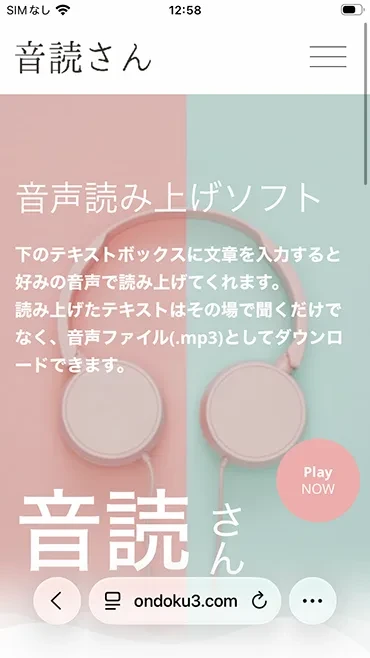
“Ondoku” is a free text-to-speech website that supports Mongolian and converts text into natural-sounding AI voices.
There’s no need to install an app; you can start using it right away in a browser on your computer or smartphone.
It’s very easy to use: select “Mongolian (Mongolia)” under “Language,” then enter the text you want read aloud!
You can have up to 1,000 characters read aloud for free each month without registering. If you sign up for a free account and log in, you can have up to 5,000 characters read aloud each month.
You can download the audio you create as an MP3 file, making it useful for all kinds of situations, such as practicing greetings before a trip, listening practice for language learning, and narration for YouTube videos.
If you want to translate Japanese text into Mongolian and turn it into audio, simply translate the text using a translation app and paste it into Ondoku. It will then be read aloud in Mongolian.
“Ondoku” also has a “Conversation” feature that lets you create a dialogue between male and female voices or alternate between Mongolian and Japanese.
If you want to create listening materials for language study, check out this article too.

Asking a native speaker to check your Mongolian pronunciation again and again can feel like you’re imposing on them.
With an AI text-to-speech website, you can listen to the pronunciation as many times as you like without worrying about imposing on anyone!
Why not try reading Mongolian aloud for free with “Ondoku”?
What are the characteristics of Mongolian writing and pronunciation?

Learning the basic characteristics of Mongolian writing and pronunciation can make it easier to understand speech audio.
Here’s a brief introduction to the Mongolian language.
Mongolian word order is “subject–object–verb,” much like Japanese.
Since its grammar is similar to Japanese and relatively easy to learn, we recommend using a text-to-speech website to learn written words and pronunciation together.
Mongolian is written using the Cyrillic alphabet
In present-day Mongolia, Mongolian is written using the “Cyrillic alphabet”, familiar from Russian.
There are 35 letters in total: the 33 letters of the Russian alphabet plus “Ө” and “Ү”.
The name of Ondoku’s female voice, “Есүй,” also contains the letter “ү.”
One thing to keep in mind is that even when Mongolian and Russian use the same Cyrillic letters, some letters are pronounced differently.
For example, the letter “у” is pronounced like “u” in Russian, but in Mongolian it sounds closer to “o.”
By the way, the traditional vertical Mongolian script is still used in China’s Inner Mongolia Autonomous Region.
When using “Ondoku” to read Mongolian aloud, make sure to enter text written in the Cyrillic alphabet.
Recommended site for OCR of vertical Mongolian script
The OCR feature of Ondoku’s sister service, “Mr. Transcription”, supports OCR of vertically written Mongolian text.
For details, see this article on the official Mr. Transcription website.
Key points of Mongolian pronunciation
A notable feature of Mongolian pronunciation is the use of long vowels, where vowels are held for an extended duration.
Long vowels are written by doubling the same vowel letter.
For example, in “Баярлалаа,” meaning “thank you,” the final “аа” is pronounced at length.
In Mongolian, shortening or lengthening a vowel can completely change a word, so it’s important to listen carefully to vowel length.
There is also a distinctive rule called vowel harmony, whereby only vowels from the same group are used within a word.
Among the consonants, for example, “л” is pronounced differently from the Japanese “r” sound. It is a distinctive sound made by letting air flow along the sides of the tongue.
The word “Баярлалаа” we saw earlier contains “л” twice, so listen to the greeting audio and check how it’s actually pronounced.
Greeting
Батаа: Male
Есүй: Female
Thank you: Баярлалаа.
How to read Mongolian aloud with next-generation AI voice “Ondoku Beta”
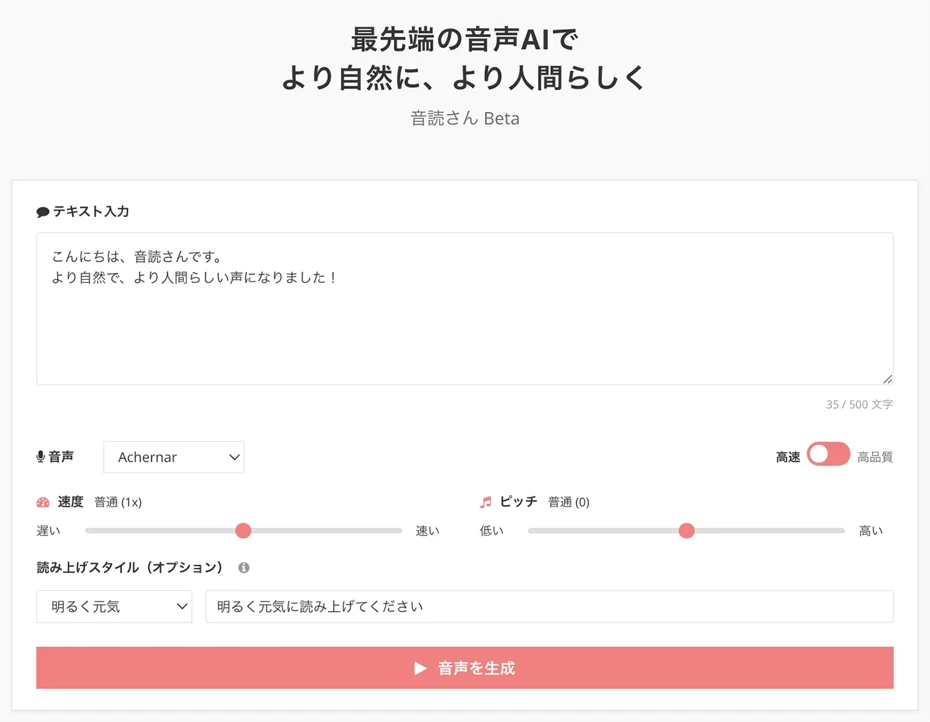
Ondoku also offers “Ondoku Beta”, a next-generation AI voice that can read text aloud in a more natural, human-like voice!
The key feature of Ondoku Beta is that you can freely specify emotions and speaking styles by writing prompts (instructions) in the “Reading Style” field.
You can also have Mongolian text read aloud just by pasting it into the text input field.
Ondoku Beta has no language selection menu, so there’s no need to set the language in advance.
Tip: Write your reading style instructions in Mongolian
When you want Ondoku Beta to read Mongolian aloud, the key is to write the instructions in the “Reading Style” field in Mongolian too.
If the language of the text to be read and the language of the instructions are different, the AI may get confused and fail to read it correctly.
Here are three handy Mongolian instructions you can copy and use as-is!
Instruction“Хөгжилтэй, эрч хүчтэй хоолойгоор уншина уу.”
Meaning: Please read aloud in a cheerful, energetic voice.
Instruction“Тайван хоолойгоор удаан уншина уу.”
Meaning: Please read aloud slowly in a calm voice.
Instruction“Мэдээний хөтлөгч шиг уншина уу.”
Meaning: Please read aloud like a news anchor.
Just copy the instruction you want to use and paste it into the “Reading Style” field.
To get the voice you want, it’s best to keep your reading style instructions as short and simple as possible.
With Ondoku Beta, you can have up to 400 characters read aloud at a time on the free plan, or up to 1,000 characters at a time on a paid plan.
For more details on how to use Ondoku Beta and voice samples, see this article.
Conclusion: Why not listen to Mongolian text-to-speech audio?
This article introduced “Ondoku”, a website where you can create Mongolian audio for free.
With “Ondoku”, you can have Mongolian text read aloud with natural pronunciation in two voices: male and female.
From short greetings like “hello” to longer passages, you can easily convert text to MP3 audio simply by entering it in Cyrillic.
Try using Mongolian AI text-to-speech audio to check pronunciation, practice listening for language study, or create narration for YouTube videos.
If you’d like to learn about voice samples in other foreign languages available on Ondoku, take a look at this article too.

Why not start by entering a phrase of your choice and listen to Mongolian audio with “Ondoku”?
■ AI voice synthesis software "Ondoku"
"Ondoku" is an online text-to-speech tool that can be used with no initial costs.
- Supports 81 languages and regions, including Japanese, English, Chinese, Korean, Spanish, French, and German
- Available from both PC and smartphone
- Suitable for business, education, entertainment, etc.
- No installation required, can be used immediately from your browser
- Supports reading from images
To use it, simply enter text or upload a file on the site. A natural-sounding audio file will be generated within seconds. You can use voice synthesis up to 5,000 characters for free, so please give it a try.

Text-to-speech software "Ondoku" can read out 5000 characters every month with AI voice for free.
You can easily download MP3s and commercial use is also possible.
If you sign up for free, you can convert up to 5,000 characters per month for free from text to speech.
Try Ondoku now.
HP:
ondoku3.com
Email: ondoku3.com@gmail.com
Email: ondoku3.com@gmail.com
Related posts
"Ondoku" is a Text-to-Speech service that anyone can use for free without installation. If you register for free, you can get up to 5000 characters for free each month. Register now for free