

Best Text-to-Speech Software: 7 Free & Paid Tools for Commercial Use
Listen to Taiwanese Mandarin Voices: 6 Male and Female Voices and Pronunciation Features
Nov. 21, 2026
I’d love to have narration in Taiwanese Mandarin.
Is there something that can read words and sentences aloud to help me study Taiwanese Mandarin?
If that sounds like you, we recommend “Ondoku”.
Here, you can listen to Taiwanese Mandarin audio samples from “Ondoku”.

You can read Taiwanese Mandarin aloud with very realistic pronunciation.
If you’d like to listen to the audio right away, start with “Listen to Taiwanese Mandarin audio samples”.
What you’ll learn in this article:
- Types of Taiwanese Mandarin voices available on Ondoku
- Taiwanese Mandarin audio samples
- Differences between Taiwanese Mandarin and Mainland Chinese vocabulary
- How to read Taiwanese Mandarin aloud with next-generation AI voices
Types of Taiwanese Mandarin voices available on “Ondoku”
There are both female and male voices.
- Chinese (Taiwan): 6 voices
Male: 3
Female: 3
Each of the six voices has its own unique pronunciation, allowing you to create realistic Taiwanese Mandarin audio.
Taiwanese Mandarin is the Chinese language spoken in Taiwan.
In the language list on Ondoku, it is displayed as “Chinese (Taiwan).”
There are also speed settings that let you make the voice speak faster or slower.
You can also adjust the pitch to make the voice higher or lower.

Changing the settings can change the overall impression and make the audio easier to understand.
It’s easy to slow down the speech when studying a language, too!

Listen to Taiwanese Mandarin audio samples from “Ondoku”

Here’s the text that was read aloud.
你好,我是Ondoku。讓我們一起享受學習中文吧。
Japanese translation: Hello, I’m Ondoku. Let’s enjoy learning Chinese together.
The voice sounds so lifelike, you might even hear it breathing—give it a listen.
Chinese (Taiwan): 6 voices
HsiaoChen: Female
HsiaoYu: Female
YunJhe: Male
cmn-TW-A: Female
cmn-TW-B: Male
cmn-TW-C: Male
Why not create Taiwanese Mandarin voiceovers with “Ondoku”?

“Ondoku” is a free text-to-speech website that supports Taiwanese Mandarin, converting text into natural-sounding AI speech.
There’s no need to install an app—you can use it right away in your computer or smartphone browser.
It’s really easy to use!
Simply select “Chinese (Taiwan)” under “Language” and enter the text you want read aloud.
What’s more, “Ondoku” is free to use!
You can have up to 1,000 characters read aloud each month without registering or logging in, and up to 5,000 characters per month with a free account.
You can download the generated audio as an MP3 file, making it useful for practicing greetings before a trip to Taiwan, language-learning listening exercises, YouTube video narration, and much more.
To convert Japanese text into Taiwanese Mandarin audio, simply paste in text translated into Traditional Chinese using a translation website.
It can then be read aloud with natural Taiwanese Mandarin pronunciation.
“Ondoku” also has a “Conversation” feature that lets you have male and female voices converse or alternate between reading Taiwanese Mandarin and Japanese.
If you’d like to create listening materials for language study, take a look at this article too.

It can feel awkward to repeatedly ask a native speaker to check your Taiwanese Mandarin pronunciation.
With an AI text-to-speech website, you can listen as many times as you like to check your pronunciation without feeling awkward!
Why not try reading Taiwanese Mandarin aloud for free with “Ondoku” today?
What’s the difference between Taiwanese Mandarin and Mainland Chinese?

Knowing the basic characteristics of Taiwanese Mandarin can help you make better use of text-to-speech audio.
Here, we’ll briefly explain the differences between Taiwanese Mandarin and Mainland Chinese.
The Chinese spoken in Taiwan is often called “Taiwanese Mandarin” outside of Taiwan.
In Taiwan, it is also called “國語” (Guóyǔ).
Chinese spoken in Taiwan is sometimes referred to as “Taiwanese,” but it’s important to note that Taiwanese (Taiwanese Hokkien) is actually a completely different language from Taiwanese Mandarin.
The audio samples in this article are in Taiwanese Mandarin.
Taiwanese Mandarin and Mainland Chinese (Putonghua) differ in their writing systems, vocabulary, and pronunciation.
The easiest difference to spot is the writing system: Taiwanese Mandarin uses Traditional Chinese characters, while Mainland Chinese uses Simplified Chinese characters.
The systems used to represent pronunciation also differ. Mainland China uses the alphabet-based “Pinyin,” while Taiwan uses 37 symbols called “Zhuyin (Bopomofo) (ㄅㄆㄇㄈ).”
With “Ondoku”, you can simply enter text written in Traditional Chinese and have it read aloud.
Pinyin is also sometimes used to study Taiwanese Mandarin
By the way, Pinyin is often used alongside Zhuyin when studying Taiwanese Mandarin.
Many books for learning Taiwanese Mandarin show Pinyin alongside Zhuyin.
Even in Taiwan, the alphabet is used for station names, road signs, and names in passports.
However, there isn’t just one way to write Taiwanese Mandarin using the alphabet.
In addition to Pinyin, which is also used in Mainland China, other systems such as “通用拼音” and “Wade–Giles” are also used.
Taiwanese Mandarin pronunciation is called “Taiwanese accent” or “Taiwanese way of speaking”
The distinctive pronunciation and speaking style of Taiwanese Mandarin are called “台灣口音” (Taiwanese accent) or “台灣腔” (Taiwanese way of speaking).
口音 (kǒu yīn) is a Chinese term meaning accent.
“腔” is a character that refers to someone’s pronunciation or way of speaking, and is used after a place name, as in “廣東腔” (Cantonese accent).
Compared with Mainland Putonghua, Taiwanese Mandarin is characterized by softer retroflex sounds and a gentler sound overall.
Taiwanese Mandarin and Mainland Chinese differ in vocabulary and expressions
Taiwanese Mandarin and Mainland Chinese sometimes use different words to express the same meaning.
Here are Taiwanese Mandarin audio samples of five everyday words.
Word
Taiwanese Mandarin audio (HsiaoChen: Female)
Video: 影片 (called “视频” in Mainland China)
Software: 軟體 (called “软件” in Mainland China)
Taxi: 計程車 (called “出租车” in Mainland China)
Plastic: 塑膠 (called “塑料” in Mainland China)
Potato: 馬鈴薯 (called “土豆” in Mainland China)
It’s interesting that even in Chinese, words like “taxi” and “software” can be completely different.
One word to be especially careful with is “土豆.”
In Mainland China, “土豆” means potato, but in Taiwan it refers to peanuts.
Ondoku also supports Mainland Putonghua and Cantonese.
Audio samples are available here, so be sure to take a look.
Taiwanese Mandarin also includes words borrowed from Japanese
Taiwanese Mandarin also uses words that originated in Japanese.
歐巴桑 (auntie)
歐吉桑 (uncle)
運將 (driver)
便當 (boxed lunch)
“歐巴桑” and “歐吉桑” are words that use Chinese character pronunciations to approximate the sounds of the Japanese words “obasan” and “ojisan.”
In Taiwan, they are used to refer to middle-aged and older women and men.
“運將” is a word meaning driver, derived from the Japanese “unchan,” a casual term for a driver.
For example, a taxi driver can be called “計程車運將.”
“便當” comes from the Japanese word “bentō” and refers to a boxed lunch.
How to read Taiwanese Mandarin aloud with next-generation AI voice “Ondoku Beta”
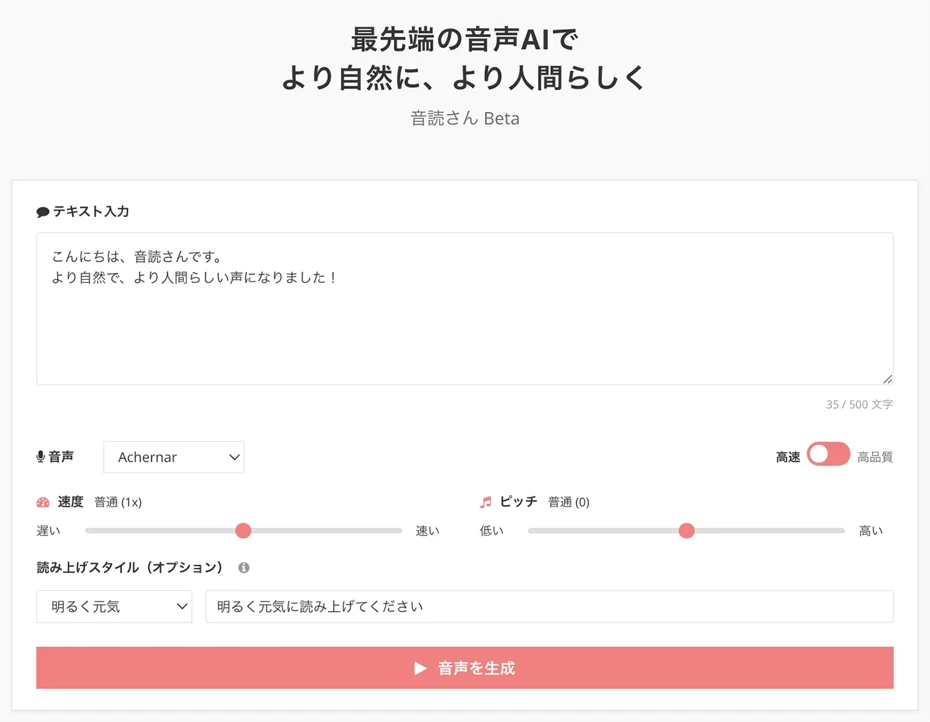
Ondoku also offers “Ondoku Beta,” a next-generation AI voice that reads aloud in a more human and natural-sounding voice!
Ondoku Beta’s key feature is that you can freely specify emotions and speaking styles by writing instructions (prompts) in the “Reading Style” field.
You can also read Taiwanese Mandarin text aloud by simply pasting it into the text input field.
Tip: Write reading style instructions in Traditional Chinese
When you want Ondoku Beta to read Taiwanese Mandarin aloud, it’s best to write the instructions in the “Reading Style” field in Traditional Chinese as well.
If the language of the text and instructions differs, the AI may get confused and fail to read the text properly.
You can also specify Taiwanese pronunciation by writing “請用台灣腔” (use a Taiwanese accent) in the instructions.
Here are three useful Taiwanese Mandarin instructions that you can copy and use as is.
Instruction: “請用台灣腔朗讀。”
Meaning: Please read aloud with Taiwanese pronunciation.
Instruction: “請用台灣腔,開朗有活力地朗讀。”
Meaning: Please read aloud with Taiwanese pronunciation, in a cheerful and energetic way.
Instruction: “請用台灣腔,像新聞主播一樣沉穩地朗讀。”
Meaning: Please read aloud with Taiwanese pronunciation, calmly like a news anchor.
Just copy the instruction you want to use and paste it into the “Reading Style” field.
For the best results, keep your reading style instructions as short and simple as possible.
Ondoku Beta can read up to 400 characters per request on the free plan and up to 1,000 characters per request on paid plans.
This article explains how to use Ondoku Beta and includes audio samples, so be sure to check it out.
Summary: Why not listen to Taiwanese Mandarin voice samples?
This article introduced “Ondoku,” a website where you can create Taiwanese Mandarin text-to-speech audio for free.
With “Ondoku”, you can have Taiwanese Mandarin text read aloud with natural pronunciation in six female and male voices.
From short greetings like “你好” to longer passages, you can easily convert Traditional Chinese text into MP3 audio simply by entering it.
Try using Taiwanese Mandarin AI text-to-speech audio to check pronunciation, practice listening for language learning, or create narration for YouTube videos.
If you’d like to listen to audio samples in other languages supported by Ondoku, be sure to check out this article as well.

Why not start by entering a word of your choice and listening to Taiwanese Mandarin audio with “Ondoku”?
■ AI voice synthesis software "Ondoku"
"Ondoku" is an online text-to-speech tool that can be used with no initial costs.
- Supports 81 languages and regions, including Japanese, English, Chinese, Korean, Spanish, French, and German
- Available from both PC and smartphone
- Suitable for business, education, entertainment, etc.
- No installation required, can be used immediately from your browser
- Supports reading from images
To use it, simply enter text or upload a file on the site. A natural-sounding audio file will be generated within seconds. You can use voice synthesis up to 5,000 characters for free, so please give it a try.

Text-to-speech software "Ondoku" can read out 5000 characters every month with AI voice for free.
You can easily download MP3s and commercial use is also possible.
If you sign up for free, you can convert up to 5,000 characters per month for free from text to speech.
Try Ondoku now.
HP:
ondoku3.com
Email: ondoku3.com@gmail.com
Email: ondoku3.com@gmail.com
Related posts
"Ondoku" is a Text-to-Speech service that anyone can use for free without installation. If you register for free, you can get up to 5000 characters for free each month. Register now for free