Recommended Text-to-Speech Software Summary: 7 Selections for Commercial Use [Free and Paid]
Inbound Tourist Support! Explanation of the Latest Methods and Benefits of Creating Multilingual Audio Guides for Free
Jan. 26, 2026

I want to create audio guides in multiple languages... what methods are available?

Audio guides have now become a standard feature at museums, art galleries, and cultural facilities.
However, isn't it often the case that they are only available in Japanese, or that the only foreign language option is English?
In fact, the ever-increasing number of inbound tourists are not only native English speakers.
By providing audio guides in languages other than English, such as Korean, Chinese, Thai, Malay, Indonesian, and Vietnamese, you can ensure higher satisfaction for a wider range of inbound visitors.
Beyond just increasing visitor numbers at museums, galleries, and cultural facilities, multilingual audio guides also help correctly convey Japanese culture to more foreigners and foster a sense of affinity for Japan.
In this article, we will explain how to make audio guides for cultural facilities—including museums, art galleries, shrines, and temples—multilingual for free!
Multilingual foreign language audio guides can be produced easily and for free by anyone.
Why not use the latest AI to welcome inbound tourists with hospitality?
[Free & Inbound-Ready] Recommended AI Tools for Multilingual Audio Guides
There is a recommended AI tool for those who want to create multilingual audio guides.
That tool is "Ondoku".
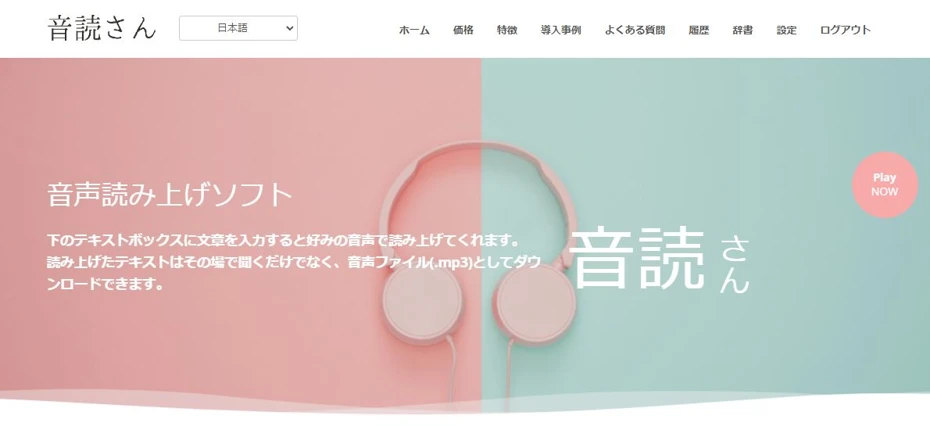
"Ondoku" is an AI text-to-speech service that can read foreign languages for free using the latest AI.
In addition to Japanese, it supports:
- English
- Chinese (supporting both Mandarin and Taiwanese Mandarin)
- Cantonese
- Korean
- Thai
- Malay
- Indonesian
- Vietnamese
It covers all the major languages of inbound tourists visiting Japan!
Because it uses the latest AI to provide native-level pronunciation, you can offer audio that is easy for inbound tourists to understand.
Furthermore, you can read up to 5,000 characters for free, so you can start making multilingual foreign language audio guides right now at no cost.
Why not use Ondoku when you want to make your inbound audio guides multilingual?
Multilingual Audio Guides are Essential for Museums, Art Galleries, and Cultural Facilities!
Audio guides are becoming increasingly popular at cultural facilities such as museums, art galleries, shrines, and temples.
However, many places still only provide Japanese and English.
In fact, multilingual support is highly recommended for future audio guides!
Multilingual Audio Guides are Recommended for Inbound Tourists

Have you felt that "the number of inbound tourists has increased lately"?
And for good reason—the number of inbound tourists is actually growing rapidly.
According to statistics from JNTO (Japan National Tourism Organization), the number of visitors to Japan in October 2024 was 3,312,000, exceeding the levels of 2019 before the COVID-19 pandemic.
For museums, art galleries, shrines, temples, and other tourist attractions and cultural facilities, inbound support is now essential.
But do you think English support alone is enough for inbound measures?
According to the same statistics, the countries and regions of origin for inbound tourists in October 2024 were as follows (for countries/regions with over 100,000 visitors):
- South Korea: approx. 730,000
- China (Mainland): approx. 580,000
- Taiwan: approx. 480,000
- United States: approx. 280,000
- Hong Kong: approx. 200,000
- Thailand: approx. 130,000
Yes, there is a very large number of inbound tourists whose native languages are Korean and Chinese.
This is where multilingual support becomes necessary.
By providing multilingual support in Korean, Chinese, and Thai in addition to English for audio guides and signage, you can attract more inbound tourists and help them develop an affinity for Japanese culture.


Reference: Malay, Indonesian, and Vietnamese are also Recommended
- Malaysia (approx. 50,000)
- Indonesia (approx. 40,000)
- Vietnam (approx. 50,000)
These are also countries with high numbers of inbound tourists.
Creating audio guides and signage in Malay, Indonesian, and Vietnamese will allow you to guide inbound tourists even more graciously.


3 Merits of Multilingual Audio Guides
Introducing multilingual audio guides to museums, art galleries, and cultural facilities offers many benefits.
Not only can you welcome inbound tourists in multiple languages to increase visitor numbers and profitability, but it also helps prevent overtourism issues and reduces the workload for facility staff.
1. Hospitality Through Multilingual Exhibition Explanations

Exhibition commentaries in museums and art galleries are often limited to Japanese and English.
Adding Korean, Chinese, or Thai to every exhibition caption can be a massive undertaking.
Therefore, we recommend starting multilingual support with audio guides first.
By explaining Japanese culture to inbound tourists through audio, you can help them develop a deeper appreciation for Japan before they return to their home countries.
It is also recommended to print and display the multilingual translated text used to create the audio.

2. Preventing Trouble by Communicating Rules and Etiquette

Museums and art galleries have specific rules such as:
- Do not cross the barrier/get too close to exhibits
- No photography
- No flash when taking photos
- No eating or drinking
Similarly, shrines and temples have visiting rules to protect precious cultural properties and a quiet environment.
With the increase in inbound tourists, unexpected trouble can occur at cultural facilities and shrines/temples.
A major cause of these issues is that manners and rules are not effectively communicated.
By conveying information in multiple languages such as Korean, Chinese, and Thai—not just English—you can prevent trouble before it happens.
While basic rules like "No Photography" or "No Eating" are simple, other rules can be more difficult to convey.
Information that is challenging to explain to people from different cultures, such as how to worship or visit shrines and temples, can be communicated clearly and smoothly through multilingual audio guides.
Audio guides are also recommended as an overtourism countermeasure for shrines, temples, tourist spots, and public transportation.
![[Preserved Edition] Solving inbound x overtourism issues! Multilingual guidance methods using the latest AI tools | Text-to-speech software Ondoku](https://storage.googleapis.com/ondoku3/image/20241215_inbound_overtourism_tmb_930.webp)

3. Reducing the Workload of Staff

Amidst ongoing labor shortages, the workload for staff at museums, galleries, and cultural facilities is constantly increasing.
In this context, handling inbound tourist correspondence is a significant challenge.
It is also very difficult to recruit staff who can communicate in foreign languages.
By guiding visitors with multilingual audio guides made with the latest AI, questions from inbound tourists will decrease, allowing staff to focus on other tasks.
In this way, multilingual audio guides offer numerous benefits for both inbound tourists and the staff of museums, art galleries, shrines, temples, and cultural facilities.
To create a better tourist spot, prevent trouble, and improve the working environment, why not create a multilingual audio guide with the latest AI?
Recommended Languages for Inbound Multilingual Audio Guides

In that case, what languages should I use to make the audio guide?
In countries and regions with many inbound tourists visiting Japan, languages other than English are primarily spoken.
Here, we explain the recommended languages for the multilingualization of audio guides and signage.
Languages of Countries/Regions with Many Inbound Tourists are Recommended

The languages widely used in countries and regions with high numbers of inbound tourists are as follows:
- South Korea: Korean
- China (Mainland): Chinese (Mandarin, Simplified Chinese)
- Taiwan: Chinese (Taiwanese Mandarin, Traditional Chinese)
- United States: English
- Hong Kong: Cantonese (Traditional Chinese)
- Thailand: Thai
- Malaysia: Malay, Chinese (Malaysian Chinese)
- Indonesia: Indonesian
- Vietnam: Vietnamese
Based on this, if you are making your audio guide multilingual, it is recommended to create audio in:
- Korean
- Chinese (for signage, it's best to create both Simplified and Traditional)
- Cantonese
- Thai
- Malay
- Indonesian
- Vietnamese
If you don't have the capacity to produce all of them, start with at least:
- Korean
- Chinese
![[2025 Edition] Complete Guide to Chinese Text-to-Speech | Detailed explanation from pronunciation practice to inbound support | Text-to-speech software Ondoku](https://storage.googleapis.com/ondoku3/image/20250111chinese_text_to_speech_tmb_930.webp)
By creating Chinese audio, you can also enable inbound tourists from places with large Chinese-speaking populations, such as Singapore and Malaysia, to use the audio guide.
*While Cantonese speakers from Hong Kong often understand Mandarin (the standard language of China), it is more considerate to create Cantonese audio if possible.
![[2025 Edition] Free Cantonese text-to-speech! How to learn efficiently through reading aloud with AI voices even for beginners | Text-to-speech software Ondoku](https://storage.googleapis.com/ondoku3/image/20250119_cantonese_text_to_speech_tmb_930.webp)
[Multilingual Support] Recommended AI Service for Inbound Tourist Guides
"Ondoku" is the recommended AI text-to-speech service for creating multilingual audio guides.
It is very easy to use.
Just paste the AI-translated foreign language text and press the "Read" button, and you can create foreign language audio with native pronunciation in just 10 seconds!
It supports 48 languages.
- English
- Chinese (supporting both Mandarin and Taiwanese Mandarin)
- Cantonese
- Korean
- Thai
- Malay
- Indonesian
- Vietnamese
It covers all the languages of inbound tourists.
What's more, Ondoku can be used for free!
You can read and download up to 5,000 characters for free, so you can start making your multilingual audio guide right away.
Why not use Ondoku when you want to create an inbound multilingual audio guide?
How to Create a Multilingual Audio Guide
How do I write sentences in Korean or Chinese? Isn't it difficult?

Don't worry!
By utilizing AI tools, anyone can create natural sentences and audio just like a native speaker!
Here, we will explain how to create a multilingual audio guide using Korean and Chinese as examples.
1. Translate the Text
First, translate the Japanese text into multiple languages.
As an example, we will translate the following text:
"Thank you for using our audio guide. First, here are some precautions when using the museum. Please do not touch the exhibits. Please do not use a flash when taking photos."
Translation Method 1: Use a Translation Site
The simplest method is to use a translation site.
For Korean and Chinese, it is recommended to use Korean or Chinese services rather than American services like DeepL.
- Korean: Papago
- Chinese: Baidu Fanyi
These are the standard services.
Inputting the example sentence into a translation site looks like this:
■ Example of Korean

"음성 가이드를 이용해 주셔서 감사합니다. 먼저 박물관을 이용하실 때 주의사항입니다. 전시품은 손대지 마세요. 사진을 찍을 때는 플래시를 사용하지 마세요."
■ Example of Chinese

"感谢您使用语音指南。首先是使用博物馆时的注意事项。请勿触摸展品。拍照的时候不要用闪光灯。"
This is how it was translated.
However, if there are no staff members who speak Korean or Chinese, you won't know if the content is correct or contains errors.
So, input the translated text and translate it back into Japanese to check.
■ Back-translation of Korean

"Thank you for using the audio guide. First, here are some precautions when using the museum. Please do not touch the exhibits. Please do not use flash when taking photos."
■ Back-translation of Chinese

"Thank you for using the audio guide. First, here are some precautions when using the museum. Do not touch the exhibits. Do not use flash when taking photos."
In this way, we can see there are no major mistakes.
However, depending on the content, mistranslations can occur. If there is a mistranslation, try the following:
- Use simpler expressions: Replace polite but vague phrases like "Please refrain from..." with simpler ones like "Is prohibited" or "Please do not...".
- Use quotation marks for proper nouns: AI translation sites will recognize terms in "quotation marks" as proper nouns.
Translation Method 2: Use an AI Service
Actually, there is a method to create native-sounding sentences even more easily.
That is to have an AI service like ChatGPT or Claude translate it for you.
For example, by instructing the AI to "Please translate the following text into native-sounding Korean/Chinese. Please also explain the content in English," you can create sentences with more natural expressions than a translation site.
The image shows an example of translating the text using the AI service "Claude".
It translated it like this:
■ Example of Korean

"오디오 가이드를 이용해 주셔서 감사합니다. 먼저 박물관 이용 시 주의사항입니다. 전시품에 손을 대지 마십시오. 사진 촬영 시 플래시를 사용하지 마십시오."
■ Example of Chinese

"感谢您使用语音导览。首先,我们来介绍参观博物馆时的注意事项。请勿触摸展品。拍照时请勿使用闪光灯。"
The expressions became more natural, such as the Korean using a transliteration of "Audio Guide" and the Chinese adding the subject "We will introduce."
Until now, when trying to create multilingual text with translation services, they tended to be literal, word-for-word translations. AI services can solve that problem!
Since the free plans are sufficient for translating audio guide scripts, we recommend utilizing AI chat services to create more natural multilingual text.
*Even when translating with AI chat services, we recommend performing a back-translation for verification.
Chinese translation is explained in detail in this article.
![[2025 Latest] 12 recommended free Chinese translation and text-to-speech services | Text-to-speech software Ondoku](https://storage.googleapis.com/ondoku3/image/chinese-translate-tts-2025-tmb_930.webp)
2. Read Aloud
Once the translated text is ready, the rest is easy.
Open the Ondoku home page and read the script for the audio guide in multiple languages.
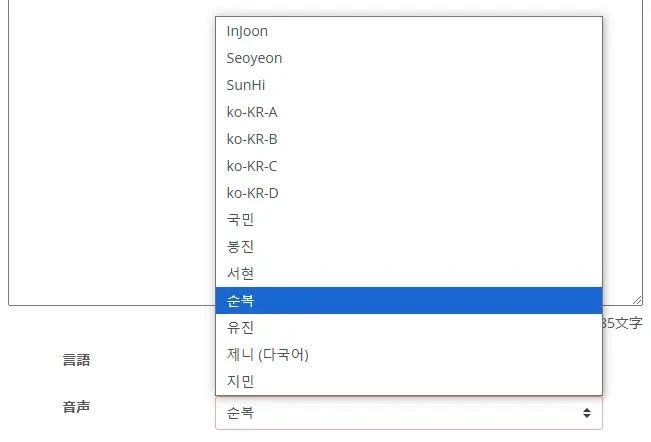
Paste the text onto the home page (here, we have pasted the Korean example).

Select the language.

Select the voice.
*You can listen to Ondoku voice samples here:
Press "Read".

The reading starts.
The reading is completed immediately (even for long audio, it takes about 10 seconds to generate).
Once the reading is complete, the display will switch, and you can listen to the audio.

If the content is correct, press the download button to save the MP3 file.
This completes the process of using Ondoku to create a multilingual audio guide.
Using the same method, you can create audio in various languages such as Cantonese, Thai, French, or Spanish!
Why not use Ondoku to create multilingual audio guides for inbound tourists?
■ AI voice synthesis software "Ondoku"
"Ondoku" is an online text-to-speech tool that can be used with no initial costs.
- Supports approximately 50 languages, including Japanese, English, Chinese, Korean, Spanish, French, and German
- Available from both PC and smartphone
- Suitable for business, education, entertainment, etc.
- No installation required, can be used immediately from your browser
- Supports reading from images
To use it, simply enter text or upload a file on the site. A natural-sounding audio file will be generated within seconds. You can use voice synthesis up to 5,000 characters for free, so please give it a try.

Text-to-speech software "Ondoku" can read out 5000 characters every month with AI voice for free.
You can easily download MP3s and commercial use is also possible.
If you sign up for free, you can convert up to 5,000 characters per month for free from text to speech.
Try Ondoku now.
HP:
ondoku3.com
Email: ondoku3.com@gmail.com
Email: ondoku3.com@gmail.com
Related posts
"Ondoku" is a Text-to-Speech service that anyone can use for free without installation. If you register for free, you can get up to 5000 characters for free each month. Register now for free
- What is Ondoku
- Start text-to-speech conversion
- Free registration
- Pricing
- Posts
- Try other free services